


23 recruiters, 2 countries and one shared reality: AI is changing recruitment, but not what we truly value.
Months ago, when we published the article “Is Artificial Intelligence Truly Showing Your Best Version?”, we explored how AI is influencing recruitment from several perspectives: the authenticity of applications, the dilemmas posed by automated tracking systems (ATS), the ethical and regulatory implications of AI legislation, and the hypotheses about how these technologies could redefine the future of talent selection.
In this new edition, we wanted to broaden our perspective and understand how all these changes are perceived from within: through the experience of those on the front line of recruitment.
To do so, we conducted an internal survey among 23 members of our Talent Acquisition teams in Portugal and Spain, to understand first-hand which transformations they are observing, how they are adapting their work, and what remains unchanged in the relationship between people and technology.
This article presents their conclusions and one shared conviction: in the future of recruitment, technology will continue to advance — but authenticity will remain the key to making a difference.
What do we see on the frontline?
The results of the survey show a landscape of visible change, though still in its early stages.
More than half of our recruiters say they detect, at least occasionally, signs of AI-generated content in the applications they review. 39% identify it in 10% to 30% of cases, and 17% more frequently, between 30% and 60% of applications.
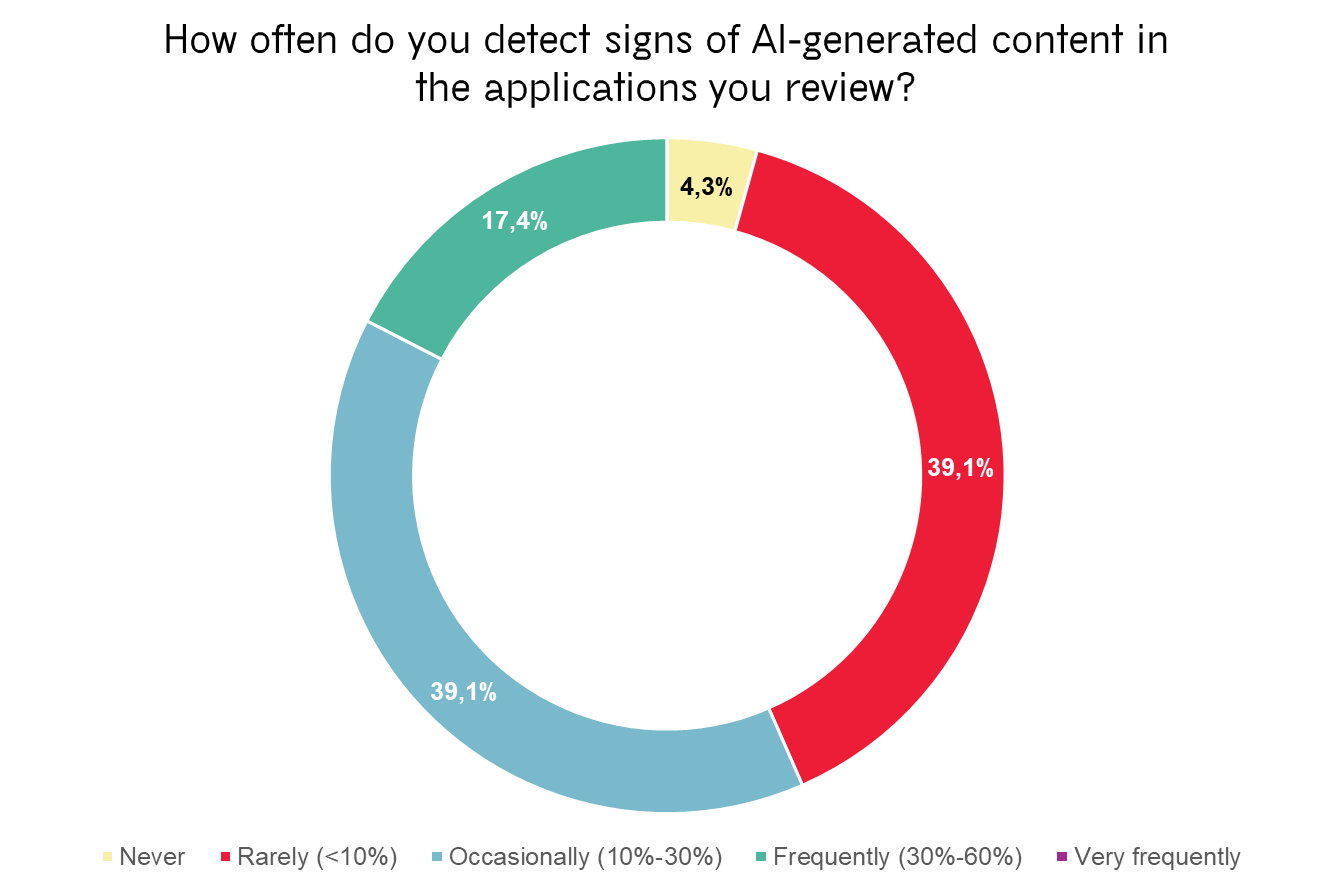
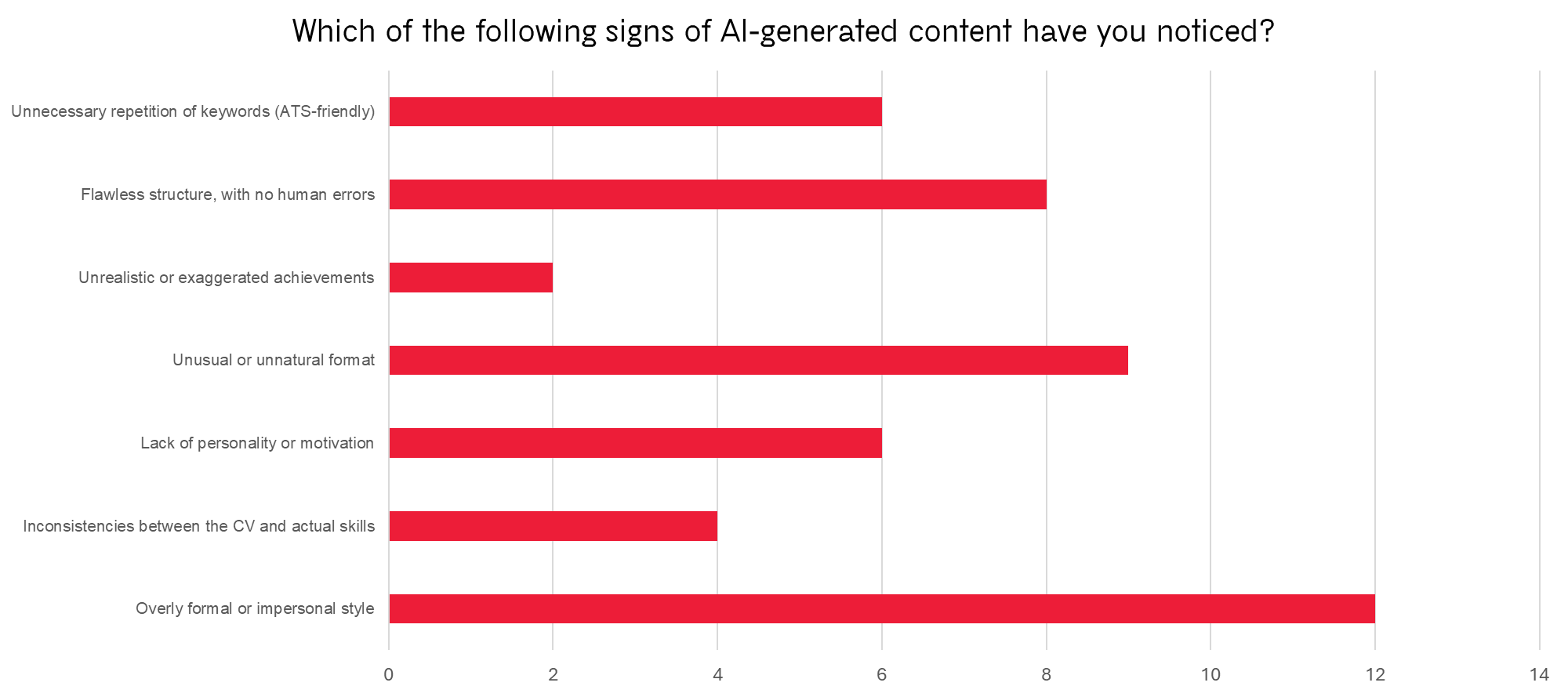
The footprint of AI, therefore, is becoming common, though not yet dominant. Our Talent Acquisition colleagues describe recurring patterns: impeccably written yet overly formal texts, technical or “packaged” language, generic phrasing, identical structures, and a surprising absence of personal details. Some even highlight the repetitive use of keywords, likely intended to achieve high compatibility with employer software systems (ATS-friendly).
One comment captures this feeling well: “The texts are coherent but too polished to sound natural.”
There are also visible changes in how candidates present their professional experience: CVs increasingly favor numbers and results, often at the expense of personal storytelling. Some recruiters interpret this as an indirect effect of automated tools, which tend to prioritise structure and optimisation over authenticity.
However, this phenomenon appears to be confined to the written stage of the process. None of the participants reported significant differences during interviews. AI may have changed how CVs are written, but it has not yet altered how people express themselves, improvise, or build human connections.
A trend confirmed beyond our trenches
According to a Gartner survey of more than 3,200 candidates, four in ten (39%) admit to having used AI at some stage of their application process. A study by the US-based Career Group Companies raises that figure to 65%, while a French survey cited by Euronews goes even further: 77% of job seekers said they have already turned to AI tools in their search.
Our own data support this trend: in an open LinkedIn survey with over +280 participants, 3 out of 4 professionals (75%) stated that they use AI regularly or occasionally when preparing their applications.
The comparison between these studies and our team’s perceptions suggests a natural gap between candidate adoption and recruiter detection. While most professionals in the market have already integrated these tools into their daily routines, their presence in selection processes is still uneven: highly visible in some cases, almost imperceptible in others.
For recruiters, this presents a new kind of challenge. Applications arrive better written but also more impersonal; the time dedicated to verifying the truthfulness and consistency of content increases, and intuition once again becomes an essential resource.
How our recruitment squads are adapting
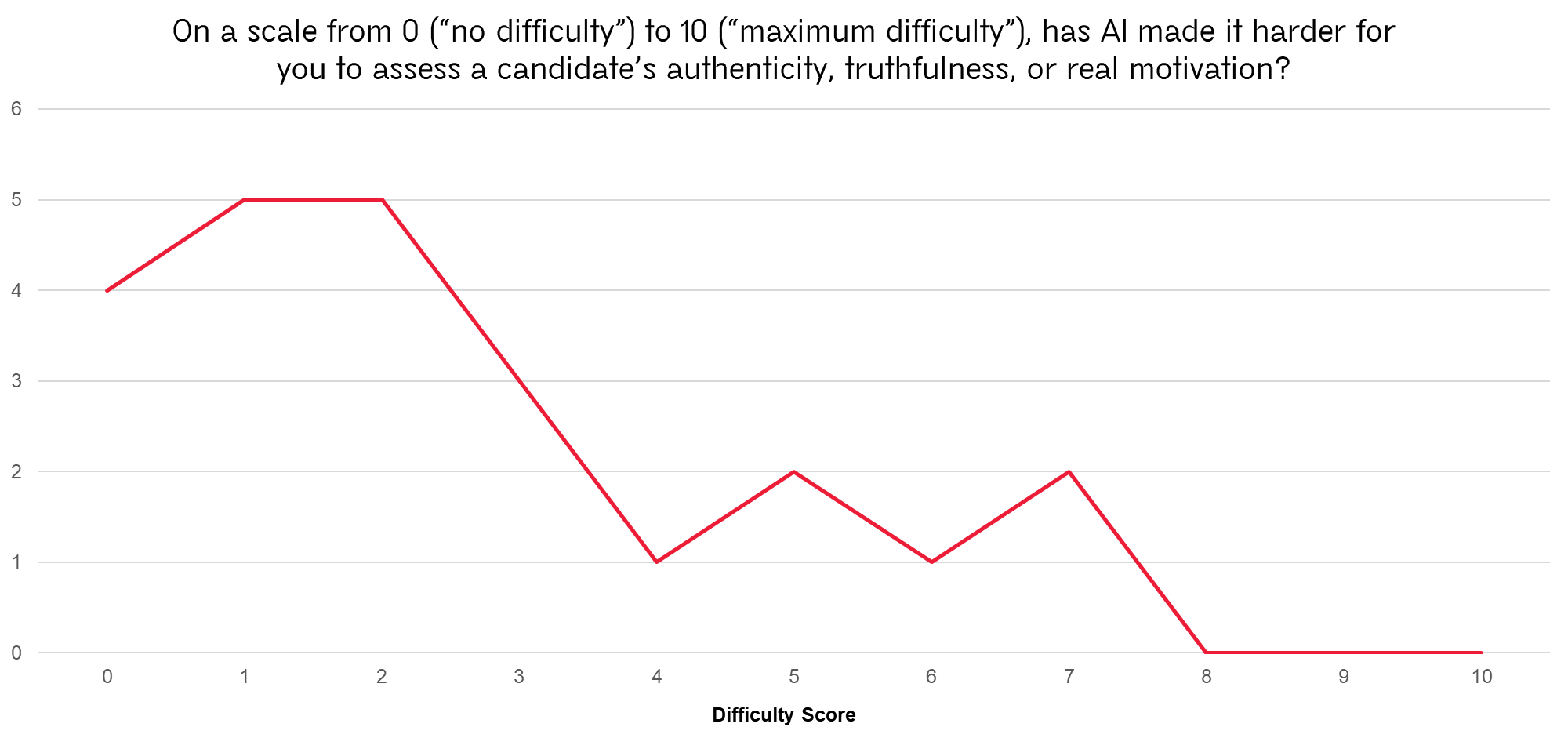
The results of our internal survey show that, while most recruiters at Neotalent Conclusion do not perceive major difficulties in identifying a candidate’s authenticity or motivation, they have begun to consciously adjust their evaluation methods.
On a scale from 0 to 10 — where 10 represented the greatest difficulty — the average score was below 3. This suggests that AI has not yet affected our recruiters’ ability to detect sincerity or engagement. However, stability does not mean passivity: teams are responding and refining their methods.
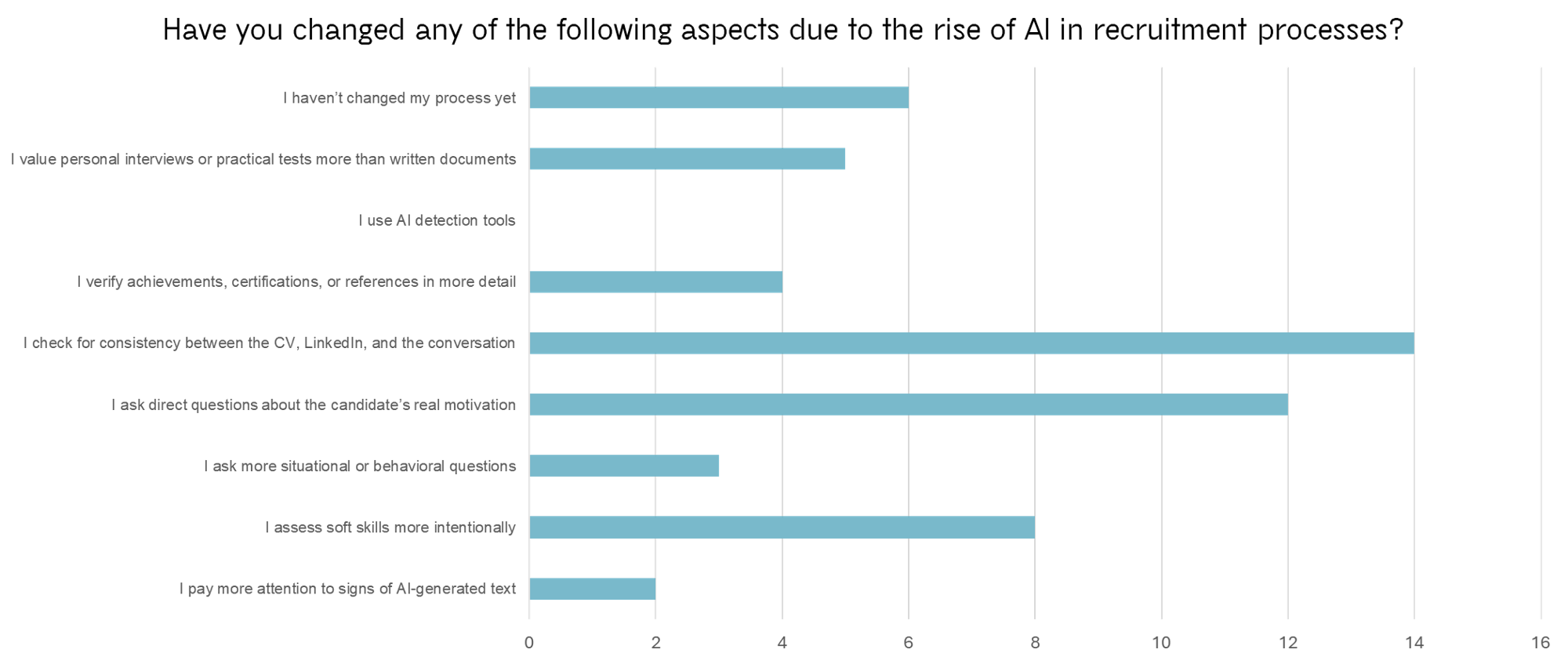
The data revealed a clear shift in focus. Nearly two-thirds of participants now cross-check the consistency between the CV, LinkedIn profile, and interview conversation. This triangulation has become a key tool for distinguishing between a polished presentation and genuine substance.
Likewise, more than half say they now ask more direct questions about a candidate’s motivation, seeking not only what they can do but why they want to do it. In parallel, almost one-third report assessing soft skills more intentionally, and five out of 23 recruiters now place greater value on in-person interviews or practical tests than on written documents.
This methodological shift reinforces a clear conclusion: as technology automates part of the interaction, attention shifts toward what cannot be automated. Empathy, coherence, and critical thinking become the true indicators of authenticity.
Meanwhile, the adoption of technological tools specifically designed to detect AI remains almost nonexistent — none of the recruiters surveyed said they use them. Rather than relying on detection software, teams trust their experience, listening skills, and cross-referencing of information to interpret nuances that no algorithm could fully grasp.
Overall, the data reflect a balanced attitude toward technological transformation: neither resistance nor dependency, but conscious adaptation focused on people.
When technology helps… and when it misleads
Our teams’ experience reveals an ambivalent relationship with candidates’ use of AI. While most agree that its impact is generally neutral or moderately positive, they also warn of certain risks when used uncritically or without personal input.
Almost half of our recruiters believe that AI has positively influenced some applications, particularly when used to improve CV structure, organise information, or prepare for interviews. 39% said this happens sometimes, while only two people reported observing it frequently. Negative effects are less common: 43% have not seen clear benefits, but neither have they experienced significant drawbacks.
At the same time, 74% said that AI use has rarely or never negatively affected their perception of a candidate. In other words, while the use of these tools is increasingly visible, it rarely harms an application — provided it is used coherently and transparently.
Several colleagues note that, when used properly, AI can be a valuable aid for candidates seeking clearer expression, particularly in another language or when describing technical competencies.
One of the most frequent observations was that these tools help candidates “structure their message better and gain confidence during interviews.” Others, however, mention drawbacks: overly similar texts, repetitive content, or inconsistencies between what is written and what candidates can later explain.
“The problem isn’t using AI, it’s delegating to it the responsibility of telling your own story,” one team member summarised.
Advice from our team
When asked to share advice for candidates who wish to use AI in their applications, our team’s message was nearly unanimous: use it as support, not as a substitute. The most frequent recommendations were:
- Use AI to structure and review, not to invent. “Use it to draft and structure, but revise with human eyes and ensure everything aligns with your real experience.”
- Preserve authenticity. “AI can help improve your writing, but the human element, authenticity, and natural tone remain indispensable.”
- Avoid over-perfection. “Language that sounds overly polished or detached from a candidate’s personal style is easy to spot and reduces credibility.”
- Apply it critically. “It’s useful for brainstorming or preparing interviews, but the message must be adapted to one’s natural way of speaking.”
Ultimately, AI is seen as a useful tool when applied with judgment, but a risky one when it replaces personal reflection.
Beyond automation
Our survey reveals a measured and profoundly human vision of the future of recruitment. For most of our recruiters, artificial intelligence will not replace the person behind the role — it will compel us to rethink it.
Far from viewing it as a threat, they see it as a tool that can save time, provide context, and increase precision, provided it is used with critical thinking.
Some describe it as “a valuable tool to optimise search processes” or “an aid that will help us become better recruiters”, while others caution that its impact will depend on training, judgement, and ethics.
Taken together, their testimonies converge on one essential idea: technology can improve the means, but not the purpose. As one participant noted, “The outcome — good or bad — of AI will depend on the discernment of those who use it.”
The consensus is clear: the true added value of recruitment will continue to lie in what cannot be automated. Tools can write, summarise, or filter, but they cannot interpret nuances, read between the lines, or recognise emotion behind a response. As another colleague put it, “AI cannot replace intuition, empathy, and human judgment in talent selection; some things can only be felt.”
That conviction runs through every response: the future of recruitment will be hybrid, but its essence will remain human. There will be more automation, more data, and greater efficiency — but also a stronger emphasis on authenticity, transparency, and genuine human connection. Perhaps, as one recruiter suggested, “in-person interviews may regain importance” — not out of nostalgia, but because direct contact remains the best antidote to technological homogenisation. Ultimately, AI is redefining the work of recruiters while reinforcing its purpose.
Recruiting talent has never been merely about identifying skills; it is about recognising potential, motivation, and human coherence. And in that realm, intelligence remains — and will remain — profoundly human.