
On World Art Day (April 15th), we brought together reflections from colleagues across the Iberian ecosystem of Conclusion who actively practice different artistic disciplines. Together, they explore a relevant question: how does artistic practice connect with professional capability?
At first glance, what our consultants do outside of work may seem unrelated to their roles in the tech world… Photography, music, embroidery, theatre, painting. Different worlds. Different rules. But this separation does not hold under closer inspection.
Across Neotalent Conclusion, these arts are not only personal interests. They are training grounds for the same capabilities required in complex technical environments: observing patterns, structuring problems, adapting to change, and thinking beyond predefined solutions.
Artistic creativity, in this context, is not ornamental. It is functional. It shapes how problems are approached, how decisions are made, and how solutions are built. What happens outside working hours often reinforces what happens within them, not by coincidence, but by transfer of skills.
What follows is their map of shared capabilities.
OBSERVE AND UNDERSTAND
Before solving a problem, there is a prerequisite: understanding it. Not superficially, but in depth (context, constraints, and hidden variables included).
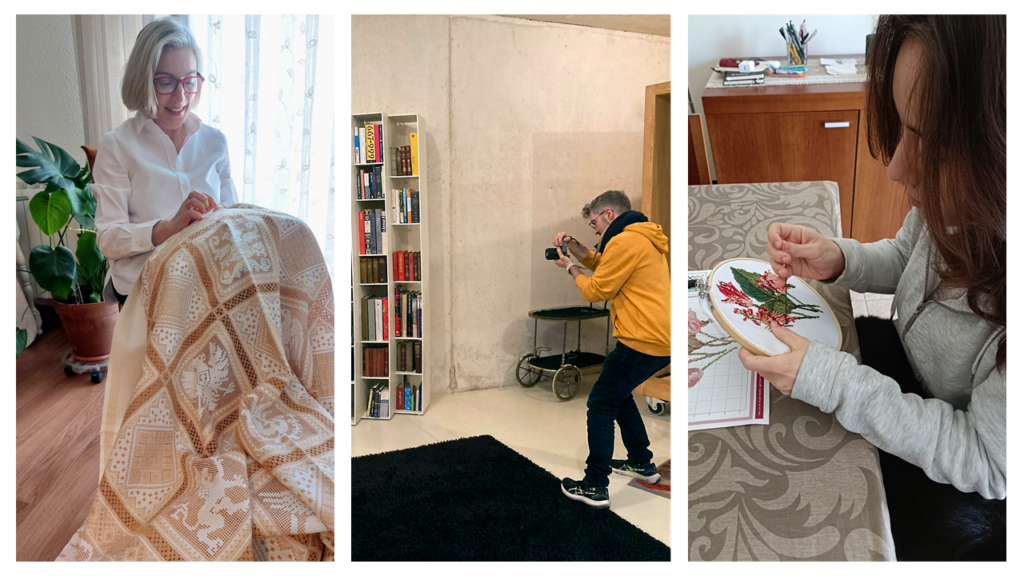
This is where many artistic disciplines converge with technical work. For Adrián Fernández, Software Engineer and photographer, observation is not passive. It is a deliberate process of reading the environment: “You have to pay attention to context (light, color, shapes) and find a creative framing. Programming is similar: you analyze the problem and everything around it before creating something new.”
The act of taking a photograph and writing code share the same foundation: nothing meaningful happens without first understanding what is in front of you.
Clara Moreno, Analyst Programmer and embroiderer, approaches her craft with the same mindset: “Before a single stitch is made, the design must be planned and every thread counted.” Precision is not optional but structural. Similarly, for Sara Santos, cross-stitching is an exercise in patience and exactness: “. The calm and precision required for crochet and cross-stitching are, without a doubt, very useful tools that I find myself applying more and more in other aspects of my personal and professional life.”
Across these disciplines, a pattern emerges: Observation is active, not passive; Detail is not secondary, but foundational; Context determines outcome.
In both art and tech, rushing into execution without fully understanding the problem leads to fragile results. The ability to observe becomes the first differentiator.
STRUCTURE AND DECOMPOSE
Creativity is often associated with spontaneity, intuition, and freedom. But in practice, especially in technical environments, it rarely works without structure.
The ability to generate ideas is only part of the equation. The ability to execute them depends on method.
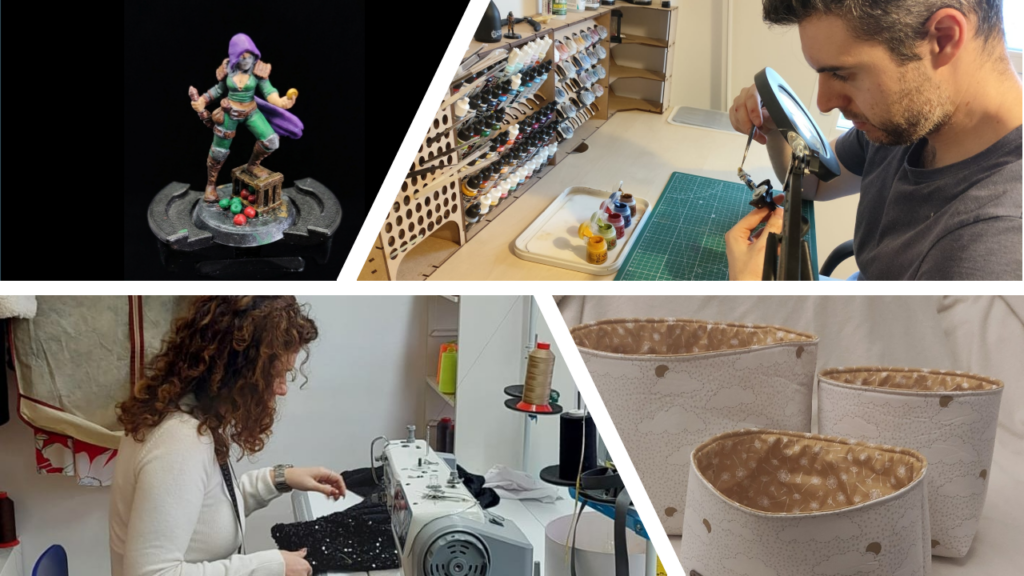
For Álvaro Vázquez, Security Administrator and miniature painter, this connection is explicit: “Whether on my desk or in my processes, chaos is the enemy. Without structure, the work falls apart. Just like a miniature is built layer by layer, complex problems are solved by breaking them into smaller, manageable pieces.”
This idea is reinforced in the experience of Andreia Monteiro, People Operations, with sewing. What began as a self-taught exploration evolved into a structured practice where preparation is critical. Before execution, there is a phase that defines everything that follows: preparation. As she describes it, “What I enjoy most is all the preparation before going to the sewing machine: choosing the right fabrics, taking measurements, preparing the patterns, and cutting the fabric.”
The visible outcome, the final piece, is only a fraction of the work. Most of the value lies in what happens beforehand.
In both art and tech, results are not driven by inspiration alone, but by the ability to organize, sequence, and control the process from start to finish.
THINK DIFFERENT
Technical problems are often approached through logic, repetition, and known frameworks. This works… until it doesn’t. When a solution cannot be found within the same mental path, something else is required: the ability to step outside the immediate context and reframe the problem.
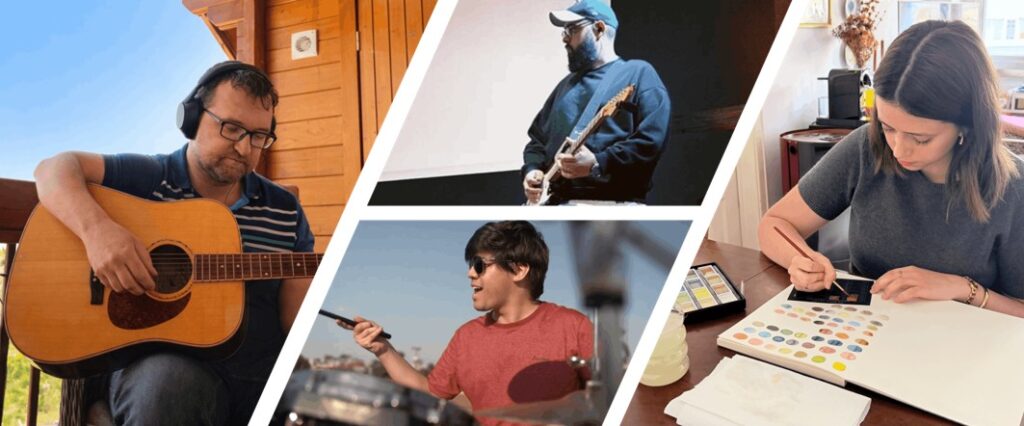
For several of our colleagues, artistic practice becomes that mechanism. Kenny Szombik, IT Consultant and guitarist, describes this shift clearly: “When I can’t figure out how to solve a problem, I pick up my guitar. As I get into the flow, new possibilities begin to emerge, helping me approach complex problems from a different perspective.”
The act of stepping away is not avoidance. It allows the mind to break from linear thinking and return with alternative approaches. For Iago Camelo, ETL Developer and guitarist, playing is a way to “escape technical stress and let creativity flow,” while developing patience and flexibility that directly translate into solving complex problems.
This interplay between structure and freedom is also visible in more visual forms of art. Francisca Ferreira, GenAI Consultant and painter, defines painting as: “a space where I unlock creativity, stimulate thinking, and gain new perspectives that I also bring into my professional day-to-day.”
And in frontend development, where user experience requires both logic and intuition, Kalliu Brasil, Frontend Developer and drummer, highlights how artistic sensitivity enhances technical execution: “When my artistic side combines with my skills as a Frontend Developer, I’m recognized for my creativity in managing challenges in user interfaces and human behavior.”
Thinking differently is not about abandoning structure or opposing logic. It is about expanding it.
LET’S WORK TOGETHER
Excellence alone is not always sufficient in complex environments. Most challenges are not solved in isolation, but through interaction, aligning perspectives, coordinating efforts, and adapting in real time.
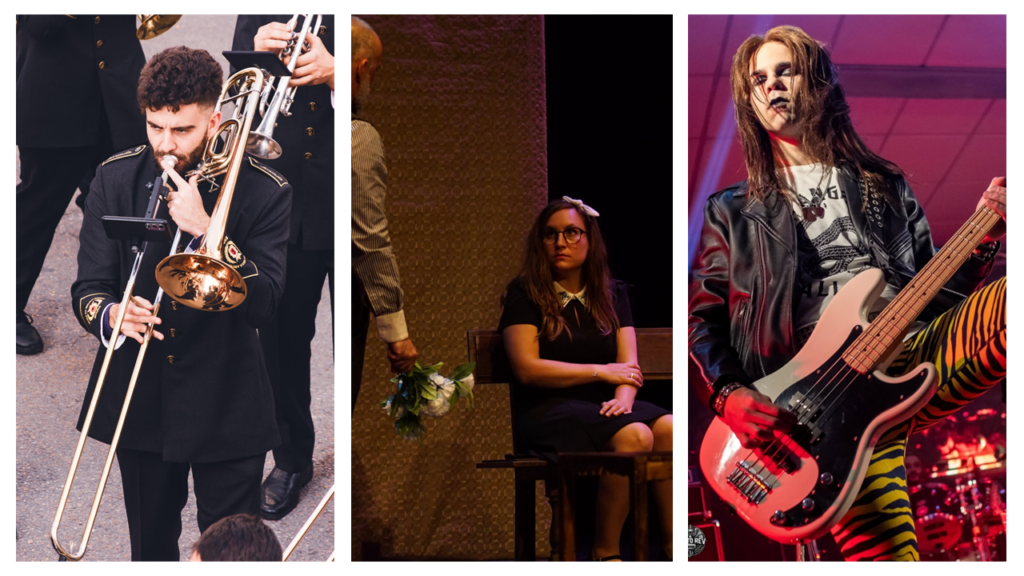
Many artistic disciplines are, by nature, collaborative. They require constant awareness of others, the ability to listen beyond words, and the flexibility to adjust one’s role within a shared outcome. For Sergio Martínez, Control Engineer and trombonist, being part of a band is a direct parallel to working in a team: “It means commitment, creativity, resilience when things don’t go as expected, and the ability to connect with others, listen, and step in when needed. These are all qualities you carry into your daily work.”
In this context, listening (just like observing, as we saw before) is not passive. It is an active skill that shapes how decisions are made and how teams respond to challenges. Sofía Medina, SCADA & Software Engineer and theatre actress, highlights this from a different angle: “On stage, you need to listen to what your colleague is saying, how they are saying it, and adapt to it. If they don’t say it, you may need to support them. It’s about integrating others’ work to achieve a good result.”
Theatre introduces an additional layer: empathy. Understanding different perspectives without judgment becomes essential — both on stage and in professional environments where multiple stakeholders coexist. Music, again, reinforces this idea at a broader level. João Ramos, Marketing Coordinator and bassist, frames it as a universal language: “A simple melody transcends languages and cultures and awakens the same emotions in anyone, anywhere in the world.”
Across these experiences, communication is not limited to verbal exchange. It includes timing, awareness, and the ability to read situations as they evolve. In both artistic and professional contexts, outcomes depend less on individual performance and more on how well people connect, adjust, and move forward together.
IDENTITY AND CONFIDENCE
Beyond skills and methodologies, there is another layer where artistic practice has a clear impact: identity. Creative disciplines are not only about producing something external. They shape how individuals see themselves, how they express ideas, and how they position their voice in different contexts.
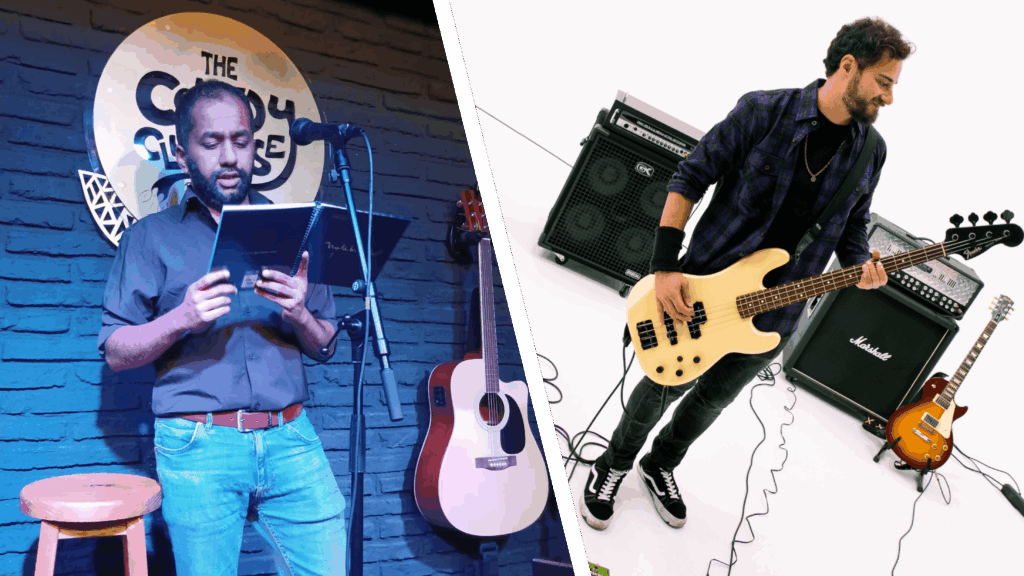
For Ranjit Raje, Business Analyst and poet, this translates directly into confidence: “It gives me the confidence to speak in public and share ideas with others. The confidence developed in personal life always helps you become a better professional.”
The ability to articulate ideas, take initiative, and step into unfamiliar situations is not developed exclusively in formal environments. It is often reinforced through spaces where experimentation is allowed. Similarly, for Nelson Lança, IT Talent Acquisition Specialist and bassist, music is not separate from who he is, it defines how he operates: “Music represents a large part of my personality. Creativity in the musical world has allowed me to develop improvisational skills in every area of my life.”
Improvisation, in this sense, is not randomness. It is the ability to respond under uncertainty, to adapt in real time, and to remain confident and effective without predefined scripts.
These are not secondary attributes. In dynamic tech environments, where change is constant and certainty is limited, they become critical differentiators.
A BROADER DEFINITION OF TALENT
These perspectives point to a consistent idea: professional capability is not built in isolation.
Observation, structure, creativity, collaboration, and confidence are not abstract traits. They are developed, often outside formal work, and transferred into it.
What emerges is a broader definition of talent: one that combines technical expertise with the ability to think, adapt, and respond in complex situations. This combination is what ultimately enables better decisions, stronger delivery, and more effective outcomes.